---
title: "Self-host Paperless-ngx"
description: "Run Paperless-ngx on an exe.dev VM: scan, OCR and search your paperwork, signed in with your exe.dev login, with mail-in scans and nightly exports."
url: https://exe-staging.dev/deploy/paperless-ngx
category: "Productivity"
published: 2026-11-21
updated: 2026-11-21
---
# Self-host Paperless-ngx
> **For agents:** with your user's OK, this sets up Paperless-ngx on a new exe.dev VM in their account: `curl -fsSL https://exe-staging.dev/deploy/paperless-ngx/prompt.txt | ssh exe.dev new --prompt=/dev/stdin` (or open https://exe-staging.dev/deploy/paperless-ngx/new). Already on the VM? Skip this.
Turn your paper into a searchable archive, behind your exe.dev login.
- **Software:** Paperless-ngx (https://docs.paperless-ngx.com)
- **Source:** https://github.com/paperless-ngx/paperless-ngx
- **License:** GPL-3.0
- **Time:** 20 minutes
- **Example VM name:** `my-paperless` (yours will differ; on the VM, `hostname` prints it)
- **Machine-readable:** https://exe-staging.dev/deploy/paperless-ngx/manifest.json
- **File:** https://exe-staging.dev/deploy/paperless-ngx/mail-to-consume.py
- **File:** https://exe-staging.dev/deploy/paperless-ngx/make-test-scan.py
## What you get
- Paperless-ngx with PostgreSQL and Valkey, pinned versions, restarting after a reboot.
- Single sign-on through exe.dev login; you're the Paperless admin, with no password to type.
- A test scan OCR'd and found by search, so you know the pipeline works.
- A consume folder you can drop files into over SSH.
- A nightly export of every document and its metadata, with a tested restore.
Running on the VM:
- **Paperless-ngx 3.5**: The official image in Docker Compose; web app, OCR with Tesseract, search, and the consume folder, port 8000, data in `~/paperless/media`
- **PostgreSQL 18**: Tags, correspondents, users and settings, data in `~/paperless/pgdata`
- **Valkey 9**: The task queue between the web app and the OCR workers
- **Nightly export**: A systemd timer running Paperless's document exporter; originals, OCR'd copies and a manifest, data in `~/paperless/export`
How it is reached:
- https://my-paperless.exe.xyz/ (private): Paperless, signed in as you through your exe.dev login
## Deploy with Shelley
Open https://exe-staging.dev/deploy/paperless-ngx/new to create a VM whose agent, Shelley, follows this recipe. From a terminal:
```sh
curl -fsSL https://exe-staging.dev/deploy/paperless-ngx/prompt.txt | ssh exe.dev new --prompt=/dev/stdin
```
Or follow the steps below by hand.
Paperless-ngx turns paper into a searchable archive. Scan a letter or
snap a receipt, and Paperless OCRs it, files it, guesses its date,
correspondent and tags, and keeps the original next to a searchable
PDF/A copy. Then "water heater" or "2025 tax" finds it in a second.
On an exe.dev VM it gets a persistent disk and HTTPS with no setup, and
it stays behind your exe.dev login: Paperless trusts the email the
proxy vouches for, so you're signed in as its admin without another
password, and nobody you haven't shared the VM with can reach it at all.
Shelley sets it up, checks OCR end to end with a test scan, and schedules
a nightly export of everything.
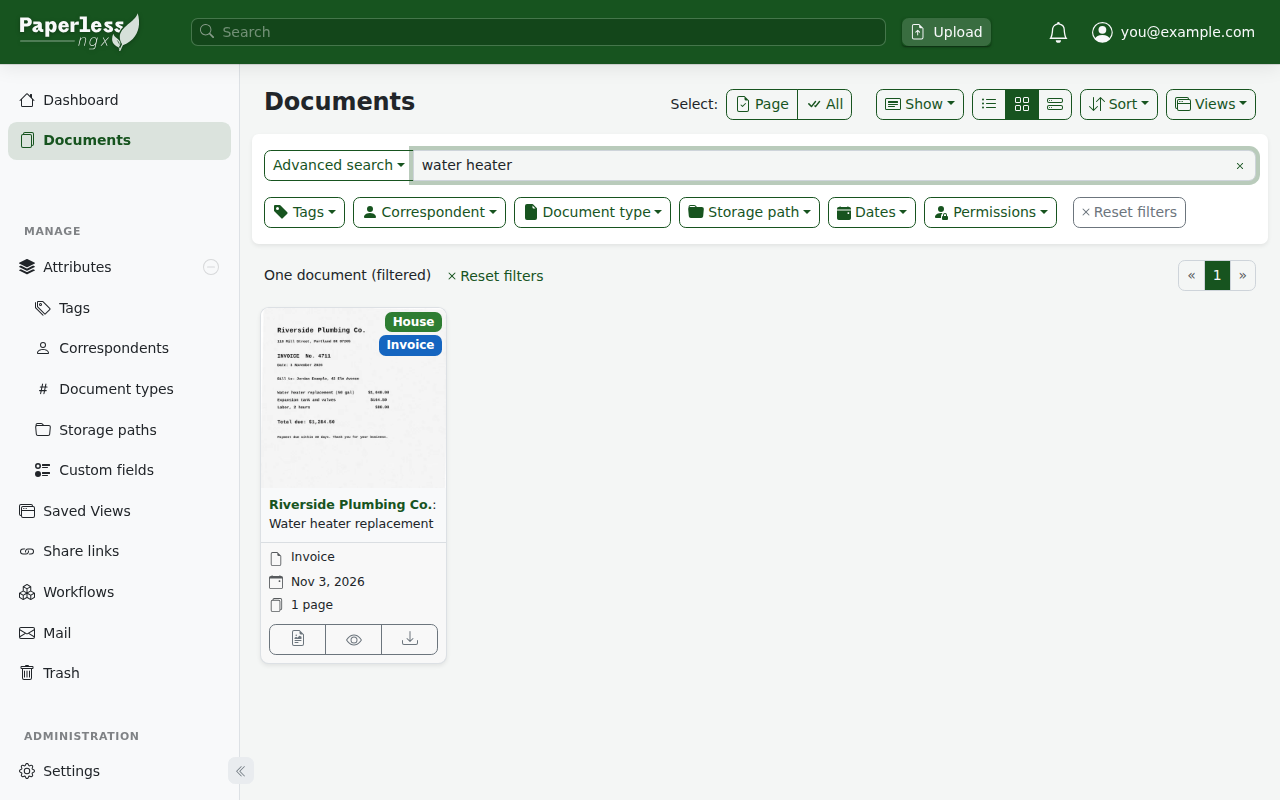
The test scan, tagged by hand, found by searching for words that were only in its image.
## Open Paperless
Open `https://my-paperless.exe.xyz/` and sign in to exe.dev if asked.
You land on Paperless's dashboard, signed in as your exe.dev email, which
is Paperless's admin account. There's already one document: the test scan
Shelley made, a plumbing invoice. Search for `water heater` to see OCR at
work, then delete it if you like.
The admin account also has a password, for the phone apps and for the
day you sign in without exe.dev. On your computer:
```bash
ssh my-paperless.exe.xyz cat paperless/admin-password
```
Keep it in your password manager. Changing it in Paperless (**My
Profile**) is fine; the file just goes stale.
## Get your paper in
Paperless takes PDFs, images (JPEG, PNG, TIFF, WebP) and plain text out
of the box; Office files and `.eml` mail need
[Tika and Gotenberg](#office-files-tika-and-gotenberg-optional). Each
file becomes a document once OCR finishes, usually within half a minute;
**File Tasks** in the sidebar shows progress and failures.
**From a browser.** Drag files onto any page, or click **Upload** in the
top bar. Your phone's browser works too: scan with its document scanner
(iOS Files, Google Drive), sign in to exe.dev once, and upload the PDF.
**Into the consume folder.** Anything copied into `~/paperless/consume`
is picked up within seconds and removed once it's in. On your computer:
```bash
scp ~/Scans/*.pdf my-paperless.exe.xyz:paperless/consume/
```
A scanner or sync tool that writes over SFTP can drop files there too.
Subfolders are ignored unless you add `PAPERLESS_CONSUMER_RECURSIVE=true`
to `paperless.env`.
**By email to the VM.** Every exe.dev VM can receive mail at
`anything@my-paperless.exe.xyz`. A small script hands the attachments of
mail from addresses you choose to Paperless; see
[Email scans to the VM](#email-scans-to-the-vm-optional).
**From a mailbox you already have.** Paperless can read an IMAP account
(a dedicated Gmail or Fastmail address, say) and file attachments by
rules. Set it up in **Settings → Mail**: add the account, then a rule for
which folder and which attachments. Gmail and Outlook need an app
password, or OAuth client IDs you register yourself; see
[Incoming email](https://docs.paperless-ngx.com/usage/#incoming-mail).
**From a phone app.** See [Phone apps](#phone-apps).
## Find things again
Search looks inside every document's OCR text, title and tags. Paperless
also learns from you: assign a correspondent, type and tags to a few
documents, and it starts suggesting them for new ones (it retrains every
hour). For rules you'd rather spell out ("anything from Riverside
Plumbing gets tag House"), use **Workflows**. Saved views put "Unpaid
invoices" or "Tax 2026" on the dashboard.
Originals are kept untouched in `~/paperless/media/documents/originals`;
the OCR'd PDF/A copies are in `.../archive`. You never need to touch
them, but they're plain files if you want them.
## Phone apps
Two community apps work with Paperless: **Swift Paperless** on iOS and
**Paperless Mobile** on Android (Play Store and F-Droid). The VM is
private, so an app needs two things: a [VM token](/docs/https-tokens-for-vms)
to pass exe.dev's proxy, and your Paperless user name and password to
sign in to Paperless itself.
Make a token that opens this VM's site and nothing else; on your
computer:
```bash
ssh exe.dev ssh-key generate-api-key --vm=my-paperless --label=paperless-phone --exp=90d
```
On the app's login screen, add a custom header (Swift Paperless:
**Extra headers**; Paperless Mobile: **Additional Headers**) named
`X-Exedev-Authorization` with the value `Bearer ` and the token. Then
enter `https://my-paperless.exe.xyz`, your exe.dev email as the user
name, and the password from `~/paperless/admin-password`.
We checked this exact pair of headers with `curl` against Paperless's API
(listing, search and upload all work), but not inside the apps; if an app
can't send a custom header, it can't reach a private VM. The token lasts
90 days; `ssh exe.dev ssh-key remove paperless-phone` revokes it sooner.
## Share it with your household
Share the VM with someone's email; on your computer:
```bash
ssh exe.dev share add my-paperless partner@example.com
```
When they open the site, Paperless creates a user named after their
email, with **no permissions**: they see an empty Paperless until you
give them some. In **Settings → Users & Groups**, add a group such as
"Household" with the view, add and change permissions you want, and put
them in it. Documents belong to whoever added them; set **Permissions**
on a document, or a default in a workflow, to share it.
> [!WARNING]
> Paperless believes the `X-ExeDev-Email` header on every browser
> request. exe.dev's proxy sets it for signed-in visitors and strips any
> copy a visitor sends, so through `https://my-paperless.exe.xyz` it can't
> be faked. But anything that reaches port 8000 *without* the proxy, such
> as another program on the VM, could send it and be you. Don't publish
> port 8000 another way (Tailscale, a tunnel, a second container network),
> and keep this VM for Paperless.
## OCR languages
Paperless OCRs in English unless told otherwise. The image already has
German (`deu`), French (`fra`), Italian (`ita`) and Spanish (`spa`); join
them with `+` for mixed documents. On the VM:
```bash
cd ~/paperless
sed -i 's/^PAPERLESS_OCR_LANGUAGE=.*/PAPERLESS_OCR_LANGUAGE=deu+eng/' paperless.env
docker compose up -d
```
For any other language, also list its Tesseract package name in
`PAPERLESS_OCR_LANGUAGES`, which installs it each time the container
starts; for Dutch and Traditional Chinese:
```bash
echo 'PAPERLESS_OCR_LANGUAGES=nld chi-tra' >> paperless.env
sed -i 's/^PAPERLESS_OCR_LANGUAGE=.*/PAPERLESS_OCR_LANGUAGE=nld+chi_tra+eng/' paperless.env
docker compose up -d
```
The package names use `-`, the OCR codes `_`. New settings apply to new
documents; to redo old ones, select them and use **Reprocess**.
## Room to grow
A page of scan is roughly 100 to 500 KB, and Paperless keeps the original
and an OCR'd copy, so 10,000 pages is a few gigabytes. The software takes
about 9 GB (images, database and search index) of a new VM's 25 GB. Check
on the VM with `df -h /`, and grow the disk when you need to; on your
computer, then on the VM:
```bash
ssh exe.dev resize my-paperless --disk=100GB
```
```bash
sudo resize2fs "$(findmnt -no SOURCE /)"
```
Plans include disk with every 2 vCPUs; past that it's billed per
[pricing](https://exe.dev/pricing). Memory is rarely the limit: a big
batch of OCR uses a couple of CPU cores for a while, and then it's idle.
## Keep your documents safe
Every night at 03:30 (UTC), a timer runs Paperless's document exporter
into `~/paperless/export`: every original, its OCR'd copy, and a
`manifest.json` with all tags, correspondents, users and settings. It
only writes what changed, and deletes files of documents you deleted.
That's a full, portable backup, readable without Paperless, but it lives
on the same disk. Copy it off; on your computer:
```bash
rsync -a my-paperless.exe.xyz:paperless/export/ ~/paperless-backup/
```
For whole-disk copies to your own S3 bucket, use
[VM backups](/docs/vm-backups). [Restore](#back-up-and-restore) brings an
export back on a new VM.
## Email scans to the VM (optional)
exe.dev delivers mail sent to `anything@my-paperless.exe.xyz` into
`~/Maildir/new` on the VM. [mail-to-consume.py](https://exe-staging.dev/deploy/paperless-ngx/mail-to-consume.py)
takes each message from an address you list, copies its PDF and image
attachments into the consume folder, and files every message away so
the mailbox never fills up. A systemd path unit runs it whenever mail
arrives.
On your computer, turn on mail for the VM:
```bash
ssh exe.dev share receive-email my-paperless on
```
On the VM, install the script and the units, and list who may send.
Replace the address with yours (one per line; add your scanner's or a
household member's):
```bash
cd ~/paperless
curl -fsSo mail-to-consume.py https://exe-staging.dev/deploy/paperless-ngx/mail-to-consume.py
chmod 755 mail-to-consume.py
echo 'you@example.com' > mail-senders
mkdir -p ~/Maildir/new ~/Maildir/cur
sudo tee /etc/systemd/system/paperless-mail.service >/dev/null </dev/null < [!WARNING]
> This sends your documents' text to the model provider, through
> exe.dev's gateway, and uses your exe.dev LLM allocation. Leave it off
> for documents you wouldn't paste into a chatbot.
On the VM:
```bash
cd ~/paperless
cat >> paperless.env <<'EOF'
PAPERLESS_AI_ENABLED=true
PAPERLESS_AI_LLM_BACKEND=openai-like
PAPERLESS_AI_LLM_ENDPOINT=https://llm.int.exe.xyz/v1
PAPERLESS_AI_LLM_MODEL=gpt-5.4-mini
PAPERLESS_AI_LLM_EMBEDDING_BACKEND=openai-like
PAPERLESS_AI_LLM_EMBEDDING_MODEL=text-embedding-3-small
EOF
docker compose up -d
```
Once the webserver is back (about a minute), build the index chat
searches in, once; after that, Paperless updates it nightly:
```bash
docker compose exec -T webserver document_llmindex rebuild
```
An AI button then appears on each document's suggestions, and a chat
box in the top bar. On our test VM, suggestions for the plumbing invoice
took about 9 seconds, and a question about it was answered in under two.
To turn it off, set `PAPERLESS_AI_ENABLED=false` and run `docker compose
up -d`.
## Office files: Tika and Gotenberg (optional)
To take Word, Excel, PowerPoint, LibreOffice files and `.eml` emails,
Paperless needs Apache Tika to read them and Gotenberg to turn them into
PDFs. They add about 3 GB of disk and 300 MB of memory. On the VM,
add the two services and three settings to `compose.yaml`:
```bash
cd ~/paperless
python3 - <<'EOF'
from pathlib import Path
p = Path("compose.yaml")
s = p.read_text()
assert "tika" not in s, "already added"
s = s.replace(" PAPERLESS_DBHOST: db\n", """ PAPERLESS_DBHOST: db
PAPERLESS_TIKA_ENABLED: 1
PAPERLESS_TIKA_GOTENBERG_ENDPOINT: http://gotenberg:3000
PAPERLESS_TIKA_ENDPOINT: http://tika:9998
""", 1)
s += """ gotenberg:
image: docker.io/gotenberg/gotenberg:8.38
restart: unless-stopped
command:
- "gotenberg"
- "--chromium-disable-javascript=true"
- "--chromium-allow-list=^file:///tmp/.*"
tika:
image: docker.io/apache/tika:3.3.1.0
restart: unless-stopped
"""
p.write_text(s)
EOF
docker compose up -d
```
These are the versions and Gotenberg flags from Paperless's own
`docker-compose.postgres-tika.yml`.
## Open it to the internet
To reach Paperless without exe.dev login (say, for an app that can't
send a custom header), make the VM public; on your computer:
```bash
ssh exe.dev share set-public my-paperless
```
The proxy then sends no `X-ExeDev-Email`, so everyone gets Paperless's
own login page, and you sign in with your email and the admin password.
Turn on two-factor login in **My Profile** first, and give every other
user a strong password. `ssh exe.dev share set-private my-paperless`
closes it again.
## The nuts and bolts
Happy clicking Deploy? You can stop here. These are the same setup steps
Shelley follows, plus the maintenance commands for later. Tested with
Paperless-ngx 3.5.1, PostgreSQL 18 and Valkey 9.
Install by hand
### Create a VM
On your computer (pick another name if `my-paperless` is taken):
```bash
ssh exe.dev new --name=my-paperless
ssh my-paperless.exe.xyz
```
All remaining installation commands run **on the VM**, as `exedev`. They
use `hostname`, so your VM can have any name.
### Get Docker ready
Enable Docker at boot, or exe.dev's on-demand Docker won't restart
Paperless after a reboot:
```bash
sudo systemctl enable --now docker.service
systemctl is-enabled docker.service
```
Expect `enabled`.
### Make the settings
This picks random passwords for the database and the Paperless admin,
and a secret key, and makes your exe.dev email (from the VM's
[reflection](/docs/integrations-reflection) service) the admin's user
name, so exe.dev login signs you in as the admin. The files are readable
only by you. It won't overwrite existing ones.
```bash
mkdir -p ~/paperless/consume ~/paperless/export && cd ~/paperless
if [ ! -f paperless.env ]; then
(
umask 077
OWNER=$(curl -fsS https://reflection.int.exe.xyz/email | jq -r .email)
DBPASS=$(openssl rand -hex 24)
openssl rand -base64 24 > admin-password
echo "POSTGRES_PASSWORD=$DBPASS" > postgres.env
cat > paperless.env < ~/paperless/compose.yaml <<'EOF'
# Paperless-ngx behind exe.dev's HTTPS proxy, after Paperless's
# docker-compose.postgres.yml.
services:
broker:
image: docker.io/valkey/valkey:9-alpine
restart: unless-stopped
volumes:
- ./redis:/data
db:
image: docker.io/library/postgres:18
restart: unless-stopped
env_file: postgres.env
environment:
POSTGRES_DB: paperless
POSTGRES_USER: paperless
volumes:
- ./pgdata:/var/lib/postgresql
webserver:
image: ghcr.io/paperless-ngx/paperless-ngx:3.5.1
restart: unless-stopped
depends_on:
- db
- broker
ports:
- "8000:8000"
env_file: paperless.env
environment:
PAPERLESS_REDIS: redis://broker:6379
PAPERLESS_DBENGINE: postgresql
PAPERLESS_DBHOST: db
USERMAP_UID: 1000
USERMAP_GID: 1000
# Sign in whoever exe.dev's proxy says is visiting (web app only).
PAPERLESS_ENABLE_HTTP_REMOTE_USER: "true"
PAPERLESS_HTTP_REMOTE_USER_HEADER_NAME: HTTP_X_EXEDEV_EMAIL
volumes:
- ./data:/usr/src/paperless/data
- ./media:/usr/src/paperless/media
- ./export:/usr/src/paperless/export
- ./consume:/usr/src/paperless/consume
EOF
cd ~/paperless
docker compose up -d
until [ "$(docker inspect -f '{{.State.Health.Status}}' "$(docker compose ps -q webserver)")" = healthy ]; do sleep 5; done
docker compose logs webserver | grep -E 'Created superuser|Paperless-ngx v'
```
The first start pulls about 4.5 GB of images and takes a few minutes;
after that, about a minute. Expect `Created superuser "you@example.com"
with provided password.` Paperless creates the admin from
`PAPERLESS_ADMIN_*` only if the user doesn't exist, so later starts
leave it alone.
### Test OCR with a scan
[make-test-scan.py](https://exe-staging.dev/deploy/paperless-ngx/make-test-scan.py)
draws a crooked, speckled one-page invoice and saves it as a PDF with no
text in it, so Paperless has to OCR it. This makes one inside the
Paperless container, drops it in the consume folder, waits for it, and
searches for words that are only in the picture:
```bash
cd ~/paperless
curl -fsS https://exe-staging.dev/deploy/paperless-ngx/make-test-scan.py |
docker compose exec -T webserver python3 - > test-scan.pdf
mv test-scan.pdf consume/
AUTH="$(grep -oP '^PAPERLESS_ADMIN_USER=\K.*' paperless.env):$(cat admin-password)"
until [ "$(curl -fsS -u "$AUTH" localhost:8000/api/documents/ | jq .count)" -ge 1 ]; do sleep 5; done
curl -fsS -u "$AUTH" 'localhost:8000/api/documents/?query=%22water%20heater%22' |
jq -r '.results[] | "\(.title), dated \(.created)"'
ls consume
```
Expect `test-scan, dated 2026-11-03` (the date OCR read off the
invoice) and an empty consume folder, within about a minute.
### Set up the nightly export
A systemd timer runs the exporter inside the container every night. It
updates the export in place, writing only what changed; `--delete`
removes files of deleted documents, so keep nothing else in `export`.
```bash
sudo tee /etc/systemd/system/paperless-export.service >/dev/null </dev/null <<'EOF'
[Unit]
Description=Nightly Paperless-ngx export
[Timer]
OnCalendar=*-*-* 03:30:00
Persistent=true
[Install]
WantedBy=timers.target
EOF
sudo systemctl daemon-reload
sudo systemctl enable --now paperless-export.timer
sudo systemctl start paperless-export.service
ls ~/paperless/export
systemctl list-timers paperless-export.timer --no-pager
```
Expect `manifest.json` and the test scan's files in the listing, and the
timer's next run tonight.
Installation done. Continue with [Open Paperless](#open-paperless).
Back up and restore
On the VM, `sudo systemctl start paperless-export.service` refreshes the
export now. Copy it off the VM as in
[Keep your documents safe](#keep-your-documents-safe).
### Restore
Paperless's importer only loads into an **empty** Paperless, so restore
onto a new VM (or move the old `data`, `media`, `pgdata` and `redis`
aside first). Follow [Get Docker ready](#get-docker-ready) and
[Make the settings](#make-the-settings). Then, before the first start,
remove the admin settings: the export brings your users back, and an
admin created at startup would collide with them. Don't open the site in
a browser until the import is done, for the same reason.
```bash
cd ~/paperless
sed -i '/^PAPERLESS_ADMIN_/d' paperless.env
```
On your computer, copy the export into the new VM's `export` folder:
```bash
rsync -a ~/paperless-backup/ my-paperless.exe.xyz:paperless/export/
```
On the VM, follow [Start Paperless](#start-paperless) (the
`Created superuser` line won't appear), then import:
```bash
cd ~/paperless
docker compose exec -T webserver document_importer ../export
```
It ends with `Updating search index...` and a progress bar. Your
documents, tags, users and settings are back, and so is the admin's old
password; the new `admin-password` file doesn't apply, so delete it.
Then [set up the nightly export](#set-up-the-nightly-export) again.
The importer also takes a `.zip` made with `document_exporter ../export
--zip`.
Update Paperless
Read the [release notes](https://github.com/paperless-ngx/paperless-ngx/releases)
for the new version, then, on the VM, export, move the pinned tag, and
restart. Replace `3.5.2` with the version you want:
```bash
cd ~/paperless
sudo systemctl start paperless-export.service
sed -i 's|paperless-ngx/paperless-ngx:.*|paperless-ngx/paperless-ngx:3.5.2|' compose.yaml
docker compose pull
docker compose up -d
until [ "$(docker inspect -f '{{.State.Health.Status}}' "$(docker compose ps -q webserver)")" = healthy ]; do sleep 5; done
docker compose logs webserver | grep 'Paperless-ngx v' | tail -n 1
docker image prune -f
```
Paperless migrates its database on start. Don't change the major
version of PostgreSQL (`postgres:18`) the same way: a new major version
can't read the old data directory. Export, then
[restore](#restore) into a fresh install instead.
Something not working?
On the VM:
```bash
cd ~/paperless
docker compose ps
docker compose logs --tail=100 webserver
```
- **`CSRF verification failed` or `Bad Request (400)`:**
`PAPERLESS_URL` in `paperless.env` must be exactly
`https://.exe.xyz`, no trailing slash. Fix it, then
`docker compose up -d`.
- **A file sits in the consume folder:** check **File Tasks**, and the
log for `consumption failed`. Unsupported types (Office files without
Tika) stay put.
- **`Not consuming ...: It is a duplicate`:** you turned on
`PAPERLESS_CONSUMER_DELETE_DUPLICATES`. Paperless 3 keeps duplicates
by default and only warns.
- **Someone you shared the VM with sees nothing:** new users get no
permissions. Add them to a group in **Settings → Users & Groups**.
- **A phone app or script gets `401` and an exe.dev message:** that's
exe.dev's proxy: send the VM token in `X-Exedev-Authorization`. A
`401` with `Invalid token` or `Authentication credentials were not
provided` comes from Paperless: check the user name and password.
- **Mailed scans don't arrive:** run `journalctl -u paperless-mail.service`.
`not in mail-senders` means the `From:` address isn't listed; nothing
at all means the message didn't arrive (over 1 MB, or rejected).
- **The webserver restarts with `PAPERLESS_SECRET_KEY` or
`PAPERLESS_DBENGINE` errors:** Paperless 3 needs both; they're in
`paperless.env` and `compose.yaml` above.
- **Down after a reboot:** run `sudo systemctl enable --now docker.service`.
## Frequently asked questions
### Why not put Paperless on the public internet?
Your archive holds bank statements, tax returns and IDs. Behind exe.dev login, nobody gets to Paperless's login page, let alone your documents, without being someone you shared the VM with. You can [make it public](#open-it-to-the-internet) later and use Paperless's own passwords and two-factor login instead, but start private.
### How do my scans get in?
Drag files into the web page from any browser, including your phone's. Or copy them into the consume folder over SSH, email them to the VM, have Paperless read an IMAP mailbox, or use a phone app with a VM token. See [Get your paper in](#get-your-paper-in).
### Does it read languages other than English?
Yes. The image ships Tesseract data for English, German, French, Italian and Spanish, and can install any other Tesseract language when it starts. See [OCR languages](#ocr-languages).
### Does it have AI?
Paperless 3 can suggest titles, tags and correspondents with an LLM, and answer questions about your documents. It works with exe.dev's LLM gateway with no API key, but it sends document text to the model: it's off unless you [turn it on](#ai-suggestions-and-chat-optional).
### How big a VM do I need?
A new exe.dev VM (2 vCPUs, 8 GB) is plenty for a household: Paperless idles at about 1.2 GB of memory, and OCR of a page takes a few seconds. Disk is what grows. See [Room to grow](#room-to-grow).
### How much does it cost?
Paperless-ngx is free and open source (GPL-3.0). You pay for your [exe.dev plan](https://exe.dev/pricing), plus extra disk if your archive outgrows it, and LLM use if you turn AI on.
## Related
- [Self-host Syncthing](https://exe-staging.dev/deploy/syncthing.md): An always-on Syncthing node: a hub and off-site copy for your devices.
- [Self-host Immich](https://exe-staging.dev/deploy/immich.md): Your photo and video library, Google Photos style, on your own disk.
- [Self-host Vaultwarden](https://exe-staging.dev/deploy/vaultwarden.md): A Bitwarden-compatible password manager for you and your team.
- [Deploy a Docker Compose app from GitHub](https://exe-staging.dev/deploy/docker-compose.md): Your compose.yaml on a VM of its own. git push to deploy.
- [Self-host Chatwoot](https://exe-staging.dev/deploy/chatwoot.md): Website chat, email and API conversations in one inbox you own.
- [Cal.diy](https://exe-staging.dev/deploy/cal-diy.md): Open-source scheduling app on exe.dev